
A month of milestones: Kneu Health at ABN and AAN
11 June 2026
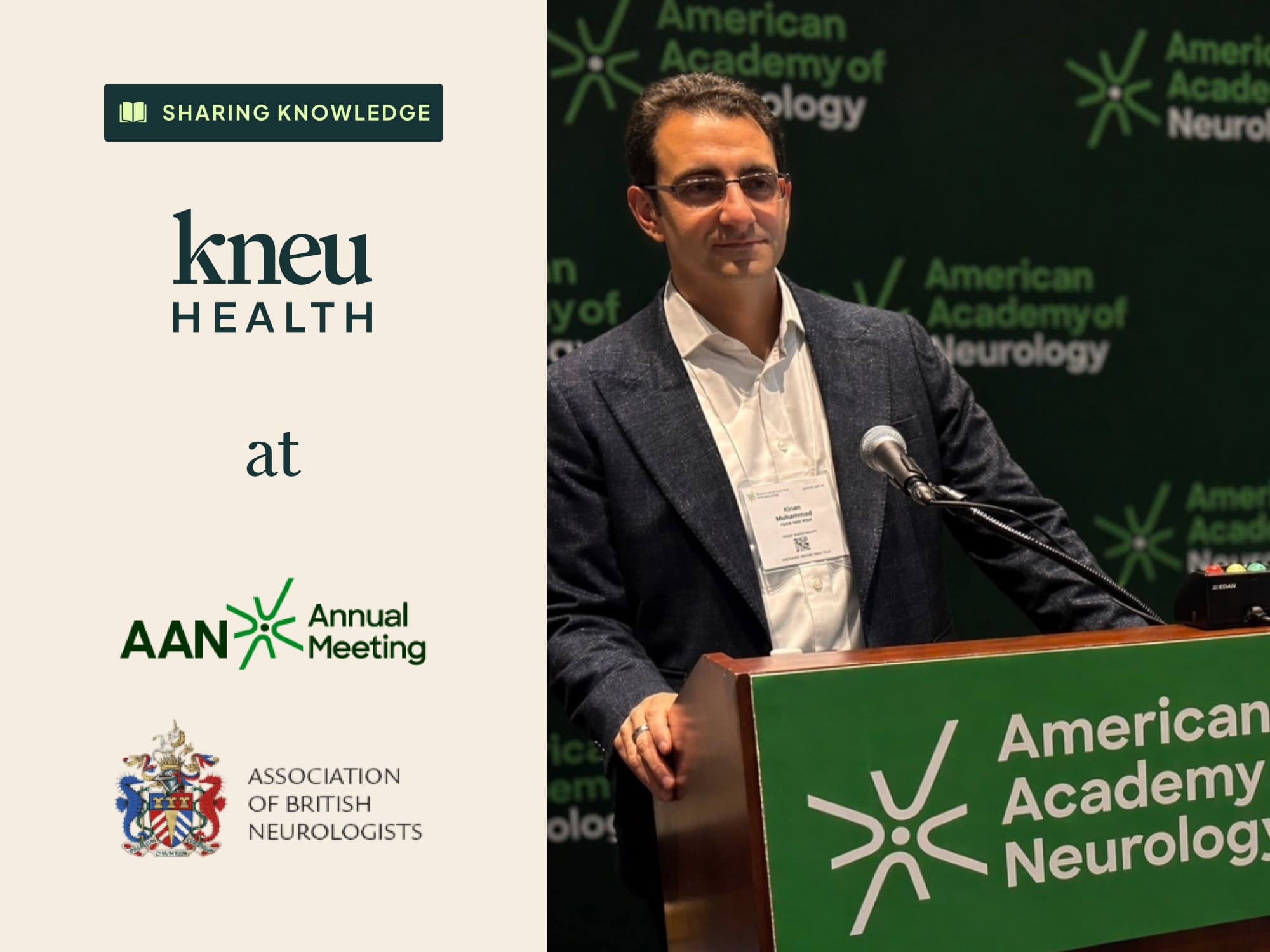
May was a busy month for Kneu Health. Across two continents and two major neurology conferences, we had the privilege of sharing real-world evidence for smartphone-based Parkinson's monitoring with clinicians from the US, UK, and beyond. Two very different rooms, but the same underlying conversation: can continuous, smartphone-based monitoring change the way we care for people living with Parkinson's, and what does that look like in real clinics, with real patients?
The response, on both sides of the Atlantic, was clear. This approach is ready for the clinic.
ABN Annual Conference, Birmingham
At the Association of British Neurologists Annual Conference, our Co-Founder and Chief Medical Officer Dr. Kinan Muhammed presented a poster detailing the outcomes of our real-world, multicentre smartphone-based monitoring in Parkinson's disease. The study set out to answer a deceptively simple question: can smartphones meaningfully support the long-term monitoring of people living with Parkinson's, outside of the clinic?
Based on real-world data, the answer is yes. Remote monitoring is not only feasible and acceptable to patients, it's clinically informative. It allows us to digitally phenotype individuals, uncover actionable insights, and drive meaningful improvements in care delivery, both within the NHS and globally.
"With growing patient populations and access challenges, we are needing to move beyond the traditional clinic visit. Longitudinal, continuous data gives us a real window into patients' lives that a 15-minute consultation simply cannot. That approach is going to need to be part of the future Parkinson's management." — Dr. Kinan Muhammed
AAN Annual Meeting, Chicago
A few weeks earlier at the American Academy of Neurology annual meeting in Chicago, Kinan presented findings from one of the largest real-world evaluations of smartphone-based Parkinson's monitoring to date — 726 patients, 13 clinical sites across the UK and US, and over 800,000 digital measures spanning voice, balance, gait, dexterity, tremor, reaction time, and cognition.
The results spoke for themselves:
53% of clinical consultations were supported by dashboard data for medication optimisation
Clinicians saved an average of 20% of consultation time
At the most mature UK site, Parkinson's-related emergency admissions fell 1.2%, while the national average rose 8.6%
11% of US patients reported avoiding an unplanned hospital or emergency visit within 3–6 months of use
93% of patients found the technology easy to use
"The 24-month results reflect the collective efforts of a collaborative network of forward-thinking clinicians across the US and UK, translating a novel approach into real-world impact for patients. As an NHS neurologist, I'm particularly proud that this work has its origins in the UK, and has now made its way to the US. It's a strong example of real innovation achieving global reach and impact." — Dr. Kinan Muhammed
What makes these findings significant is their context. These are not results from a controlled trial, they come from routine clinical care, embedded into existing workflows across different health systems and patient populations. That's what makes them matter.
Read: Neurology Live's highlights from Kinan's talk at AAN.
If you're interested to learn more about our healthcare solutions or research, contact our team or request a demo.